Printable reference chart
Fraction Chart: Decimals and Percents
Use this chart to look up fraction to decimal and decimal to fraction conversions, alongside percent values and equivalent fractions. Filter it by denominator family, or open any row to see the value worked out. The whole chart also fits on one A4 page.
- 37 fractions
- PDF & PNG
- One A4 page
- No sign-up
Look up any value
Fraction, decimal, and percent chart
37 fractions · 10 denominator families
| Fraction | Equivalent Fractions | Decimal | Percent |
|---|---|---|---|
| 2/4, 3/6, 4/8 | 0.5 | 50% | |
| 2/6, 3/9, 4/12 | 0.3333 | 33.3% | |
| 4/6, 6/9, 8/12 | 0.6667 | 66.7% | |
| 2/8, 3/12, 4/16 | 0.25 | 25% | |
| 6/8, 9/12, 12/16 | 0.75 | 75% | |
| 2/10, 3/15, 4/20 | 0.2 | 20% | |
| 4/10, 6/15, 8/20 | 0.4 | 40% | |
| 6/10, 9/15, 12/20 | 0.6 | 60% | |
| 8/10, 12/15, 16/20 | 0.8 | 80% | |
| 2/12, 3/18, 4/24 | 0.1667 | 16.7% | |
| 10/12, 15/18, 20/24 | 0.8333 | 83.3% | |
| 2/16, 3/24, 4/32 | 0.125 | 12.5% | |
| 6/16, 9/24, 12/32 | 0.375 | 37.5% | |
| 10/16, 15/24, 20/32 | 0.625 | 62.5% | |
| 14/16, 21/24, 28/32 | 0.875 | 87.5% | |
| 2/18, 3/27, 4/36 | 0.1111 | 11.1% | |
| 4/18, 6/27, 8/36 | 0.2222 | 22.2% | |
| 8/18, 12/27, 16/36 | 0.4444 | 44.4% | |
| 10/18, 15/27, 20/36 | 0.5556 | 55.6% | |
| 14/18, 21/27, 28/36 | 0.7778 | 77.8% | |
| 16/18, 24/27, 32/36 | 0.8889 | 88.9% | |
| 2/20, 3/30, 4/40 | 0.1 | 10% | |
| 6/20, 9/30, 12/40 | 0.3 | 30% | |
| 14/20, 21/30, 28/40 | 0.7 | 70% | |
| 18/20, 27/30, 36/40 | 0.9 | 90% | |
| 2/24, 3/36, 4/48 | 0.0833 | 8.3% | |
| 10/24, 15/36, 20/48 | 0.4167 | 41.7% | |
| 14/24, 21/36, 28/48 | 0.5833 | 58.3% | |
| 22/24, 33/36, 44/48 | 0.9167 | 91.7% | |
| 2/32, 3/48, 4/64 | 0.0625 | 6.3% | |
| 6/32, 9/48, 12/64 | 0.1875 | 18.8% | |
| 10/32, 15/48, 20/64 | 0.3125 | 31.3% | |
| 14/32, 21/48, 28/64 | 0.4375 | 43.8% | |
| 18/32, 27/48, 36/64 | 0.5625 | 56.3% | |
| 22/32, 33/48, 44/64 | 0.6875 | 68.8% | |
| 26/32, 39/48, 52/64 | 0.8125 | 81.3% | |
| 30/32, 45/48, 60/64 | 0.9375 | 93.8% |
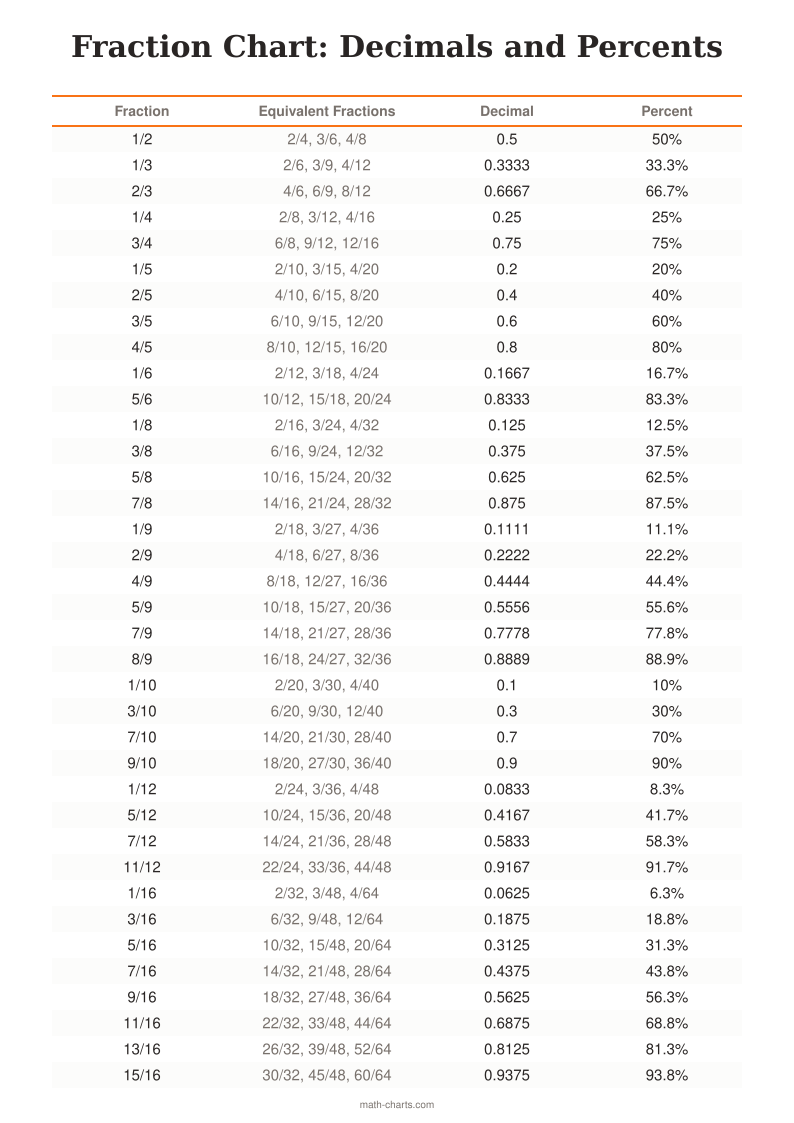
The printable page
What is on the printed chart
The PDF is one A4 page grouped by denominator family, so halves, thirds, and fourths sit together instead of being scattered alphabetically. Each row carries the fraction in simplest form, three equivalent fractions, its decimal, and its percent. Print one copy for the wall and a second as the answer key.
- Grouped by family
- Denominators 2 to 16
- One A4 page
Working in inches?
Fractions of an inch, decimal, and millimetres
The chart above is for the classroom. This one is for the bench, the workshop, or the drawing: every 64th of an inch to its exact decimal value and its millimetre equivalent, with the values a tape measure actually carries marked out.
- 63 values
- Exact decimals
- Millimetres
| Fraction of an inch | Decimal (in) | Millimetres |
|---|---|---|
| 1/64 | 0.015625 | 0.397 |
| 1/32 | 0.03125 | 0.794 |
| 3/64 | 0.046875 | 1.191 |
| 1/16tape | 0.0625 | 1.587 |
| 5/64 | 0.078125 | 1.984 |
| 3/32 | 0.09375 | 2.381 |
| 7/64 | 0.109375 | 2.778 |
| 1/8tape | 0.125 | 3.175 |
| 9/64 | 0.140625 | 3.572 |
| 5/32 | 0.15625 | 3.969 |
| 11/64 | 0.171875 | 4.366 |
| 3/16tape | 0.1875 | 4.762 |
| 13/64 | 0.203125 | 5.159 |
| 7/32 | 0.21875 | 5.556 |
| 15/64 | 0.234375 | 5.953 |
| 1/4tape | 0.25 | 6.350 |
| 17/64 | 0.265625 | 6.747 |
| 9/32 | 0.28125 | 7.144 |
| 19/64 | 0.296875 | 7.541 |
| 5/16tape | 0.3125 | 7.938 |
| 21/64 | 0.328125 | 8.334 |
| 11/32 | 0.34375 | 8.731 |
| 23/64 | 0.359375 | 9.128 |
| 3/8tape | 0.375 | 9.525 |
| 25/64 | 0.390625 | 9.922 |
| 13/32 | 0.40625 | 10.319 |
| 27/64 | 0.421875 | 10.716 |
| 7/16tape | 0.4375 | 11.112 |
| 29/64 | 0.453125 | 11.509 |
| 15/32 | 0.46875 | 11.906 |
| 31/64 | 0.484375 | 12.303 |
| 1/2tape | 0.5 | 12.700 |
| 33/64 | 0.515625 | 13.097 |
| 17/32 | 0.53125 | 13.494 |
| 35/64 | 0.546875 | 13.891 |
| 9/16tape | 0.5625 | 14.287 |
| 37/64 | 0.578125 | 14.684 |
| 19/32 | 0.59375 | 15.081 |
| 39/64 | 0.609375 | 15.478 |
| 5/8tape | 0.625 | 15.875 |
| 41/64 | 0.640625 | 16.272 |
| 21/32 | 0.65625 | 16.669 |
| 43/64 | 0.671875 | 17.066 |
| 11/16tape | 0.6875 | 17.462 |
| 45/64 | 0.703125 | 17.859 |
| 23/32 | 0.71875 | 18.256 |
| 47/64 | 0.734375 | 18.653 |
| 3/4tape | 0.75 | 19.050 |
| 49/64 | 0.765625 | 19.447 |
| 25/32 | 0.78125 | 19.844 |
| 51/64 | 0.796875 | 20.241 |
| 13/16tape | 0.8125 | 20.637 |
| 53/64 | 0.828125 | 21.034 |
| 27/32 | 0.84375 | 21.431 |
| 55/64 | 0.859375 | 21.828 |
| 7/8tape | 0.875 | 22.225 |
| 57/64 | 0.890625 | 22.622 |
| 29/32 | 0.90625 | 23.019 |
| 59/64 | 0.921875 | 23.416 |
| 15/16tape | 0.9375 | 23.813 |
| 61/64 | 0.953125 | 24.209 |
| 31/32 | 0.96875 | 24.606 |
| 63/64 | 0.984375 | 25.003 |
What does this fraction chart show?
It lists 37 common fractions with denominators of 2, 3, 4, 5, 6, 8, 9, 10, 12, and 16. Each row gives the fraction in simplest form, three equivalent fractions, its decimal value, and its percent value. The chart leaves out fractions that reduce to a row already shown. For example, 6/8 is not a separate row because it reduces to 3/4. Simplify an unlisted fraction first, then look for the reduced form.
How do I use the chart in either direction?
Start with the value you know and stay on the same row. You do not need to calculate anything when the value is already in the table.
From a fraction
Find the fraction in the first column and read to the right. The 3/8 row gives 0.375 and 37.5%. If the fraction is not listed, reduce it first: 15/24 divides by 3 to become 5/8, so its decimal is 0.625 and its percent is 62.5%.
From a decimal or percent
Find the decimal or percent, then read left to the fraction. The 0.625 row points to 5/8. For a percent, move the decimal point two places left before searching: 75% becomes 0.75, which is 3/4. Use the equivalent-fractions column when you need a different denominator.
How do I turn a fraction into a decimal?
Divide the numerator by the denominator. The fraction bar means division, so 3/8 means 3 ÷ 8. To turn the decimal into a percent, multiply it by 100. These examples show the same steps used to make the chart.
| Fraction | Division | Decimal | Percent |
|---|---|---|---|
| 1/4 | 1 ÷ 4 | 0.25 | 25% |
| 3/8 | 3 ÷ 8 | 0.375 | 37.5% |
| 2/3 | 2 ÷ 3 | 0.6667 | 66.7% |
| 5/6 | 5 ÷ 6 | 0.8333 | 83.3% |
| 7/16 | 7 ÷ 16 | 0.4375 | 43.8% |
When the decimal terminates, keep the exact result: 3/8 is exactly 0.375. When it continues forever, the chart rounds the decimal to four places and the percent to one decimal place. That is why 2/3 appears as 0.6667 and 66.7% rather than a finished exact decimal.
Why do some decimals repeat?
A fraction in simplest form has a terminating decimal only when its denominator is built from factors of 2 and 5. That is why fractions such as 1/4, 3/8, and 7/10 end, while thirds, sixths, ninths, and twelfths often repeat. For example, 1/3 is 0.3333… and 5/6 is 0.8333…. The chart marks those repeating rows, so you can tell a rounded value from an exact one at a glance. If you continue a calculation, use the fraction or the full calculator result rather than the rounded number printed in the chart.
How can I check a conversion?
Use the relationship between all three forms. For a proper fraction, the decimal should be between 0 and 1 and the percent should be between 0% and 100%. Multiplying the decimal by 100 must give the percent: 0.4375 × 100 = 43.75%, shown as 43.8% after rounding. You can also multiply the decimal by the denominator. For 3/8, 0.375 × 8 returns 3, the numerator. Finally, equivalent fractions must multiply or divide the numerator and denominator by the same number; 3/8, 6/16, and 9/24 therefore represent the same value.
More printable number charts
Fractions are easier once counting and place value are secure. These charts cover the groundwork, and they print on the same one-page A4 layout.